Jessie Toy Story Pictures
When fans search for jessie toy story pictures online, they’re often struck by how remarkably consistent yet subtly different the beloved cowgirl character appears across the Toy Story sequels. Jessie, the spirited yodeling cowgirl who captured audiences’ hearts, has remained one of Pixar’s most visually distinctive characters throughout Toy Story 2, Toy Story 3, and Toy Story 4. Her appearance tells a story of technological advancement in animation while maintaining the core characteristics that make her instantly recognizable. This article explores the fascinating evolution of Jessie’s visual design across these three beloved films.
Jessie’s Introduction in Toy Story 2
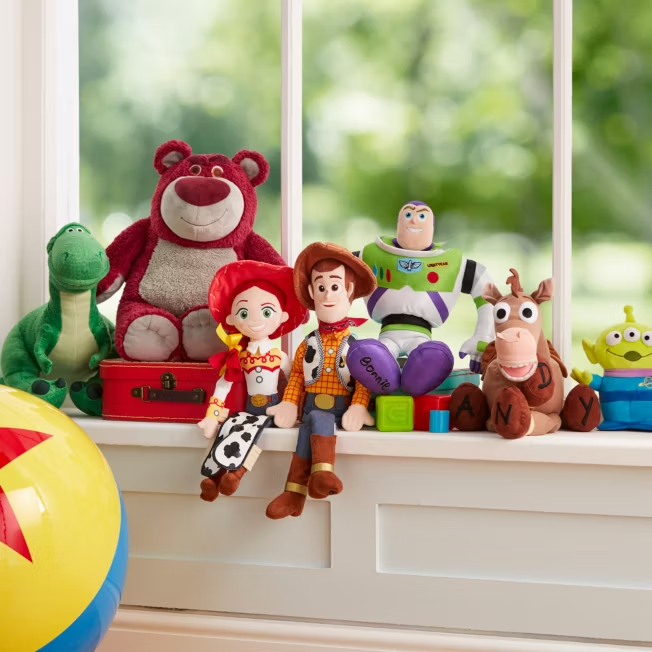
Jessie made her debut in Toy Story 2, and jessie toy story pictures from this film showcase Pixar’s animation capabilities at the turn of the millennium. Her design was vibrant and eye-catching, featuring her signature red yarn hair styled in a long braid, bright green eyes, and a cheerful cowgirl outfit. The outfit consisted of a white shirt with yellow and red accents, blue jeans, white and yellow chaps with cowhide patterns, and brown cowboy boots. Her yellow hat with a white lace trim completed the classic western look.
In this first appearance, Jessie’s facial features were designed to convey both strength and vulnerability. Her large expressive eyes could shift from joyful exuberance to deep sadness within moments, particularly during her heartbreaking “When She Loved Me” sequence. The animation technology of 1999 allowed for impressive detail in her fabric textures and hair movement, though these elements would see significant refinement in later films.
The Visual Refinement in Toy Story 3
By the time Toy Story 3 arrived in 2010, jessie toy story pictures revealed substantial improvements in animation quality while preserving Jessie’s essential character design. The eleven-year gap between films brought remarkable technological advances that Pixar utilized to enhance every aspect of her appearance. Her red yarn hair displayed more intricate individual strands and more realistic movement physics. The texture work on her clothing became notably more detailed, with visible stitching, fabric weaves, and weathering that made her look like a genuinely well-loved toy.
The lighting and shading techniques applied to Jessie in Toy Story 3 created greater depth and dimensionality. Her skin had a more polished plastic appearance that better reflected her nature as a manufactured toy, while still maintaining warmth and personality. The environmental lighting interacted more realistically with her surfaces, creating subtle shadows and highlights that added richness to every scene. Her facial expressions benefited from improved rigging systems, allowing for more nuanced emotional performances that could convey complex feelings through minute changes in her features.
The color palette in jessie toy story pictures from Toy Story 3 remained faithful to the original design but appeared more vibrant and saturated thanks to improved rendering capabilities. Her red hair seemed to glow with life, her green eyes sparkled with greater clarity, and the yellows and whites of her outfit had a cleaner, more defined appearance.
Toy Story 4 and Peak Visual Fidelity
When examining jessie toy story pictures from Toy Story 4, released in 2019, the technological leap forward becomes immediately apparent. Nearly two decades of animation advancement separated this film from Jessie’s debut, and every pixel reflected that progress. Her yarn hair achieved an almost tactile quality, with individual fibers visible and realistic light scattering that made it look genuinely like yarn rather than just an approximation. The way her braid moved and bounced had weight and momentum that felt completely natural.
The fabric simulation in Toy Story 4 represented perhaps the most significant visual upgrade for Jessie. Her outfit displayed realistic wrinkles, stretching, and compression as she moved. The cowhide pattern on her chaps had subtle variations and imperfections that made each spot unique. Even small details like the way her shirt tucked into her jeans or how her chaps overlapped her boots showed meticulous attention to realistic toy construction.
Jessie’s face in Toy Story 4 maintained her characteristic expressions while benefiting from subsurface scattering technology that gave her plastic skin a more authentic appearance. Light penetrated slightly into her surface before reflecting back, creating the subtle translucency that real plastic toys exhibit. Her eyes had incredible depth, with clearly visible painted details, reflections, and even tiny imperfections that added authenticity.
Consistency Across Character Design
Despite the technological improvements visible in jessie toy story pictures across all three films, Pixar maintained remarkable consistency in Jessie’s core design elements. Her proportions remained constant, ensuring that audiences would instantly recognize her regardless of which film they were watching. Her color scheme never wavered, with the same specific shades of red, yellow, white, and blue appearing in each installment. This consistency was crucial for maintaining character recognition and emotional connection across nearly two decades of storytelling.
The animators also preserved Jessie’s characteristic poses and mannerisms. Her enthusiastic stance, the way she tips her hat, her energetic movements, and her expressive yodeling all remained consistent visual signatures. This consistency in character animation ensured that improvements in technology enhanced rather than altered who Jessie fundamentally was as a character.
Conclusion
The journey through jessie toy story pictures from Toy Story 2, Toy Story 3, and Toy Story 4 reveals a fascinating balance between technological progress and artistic consistency. Each film showcased the cutting edge of animation technology available at its release date, yet Jessie remained unmistakably herself throughout. The improvements in hair simulation, fabric dynamics, lighting, texturing, and facial animation made her progressively more realistic and visually impressive while never compromising the warmth and personality that made audiences fall in love with her initially. Jessie’s visual evolution stands as a testament to Pixar’s commitment to both technical excellence and storytelling consistency, proving that advancing technology can enhance beloved characters without fundamentally changing what makes them special. For fans collecting and comparing these images across the years, Jessie represents not just a beloved character but a visual timeline of animation history itself.
About the Author